
Put premium
Sell a cash-secured put on a quality company at a price you'd genuinely be willing to pay. Collect premium up front. If you're not assigned, reassess and repeat. If you are, move to the next phase.
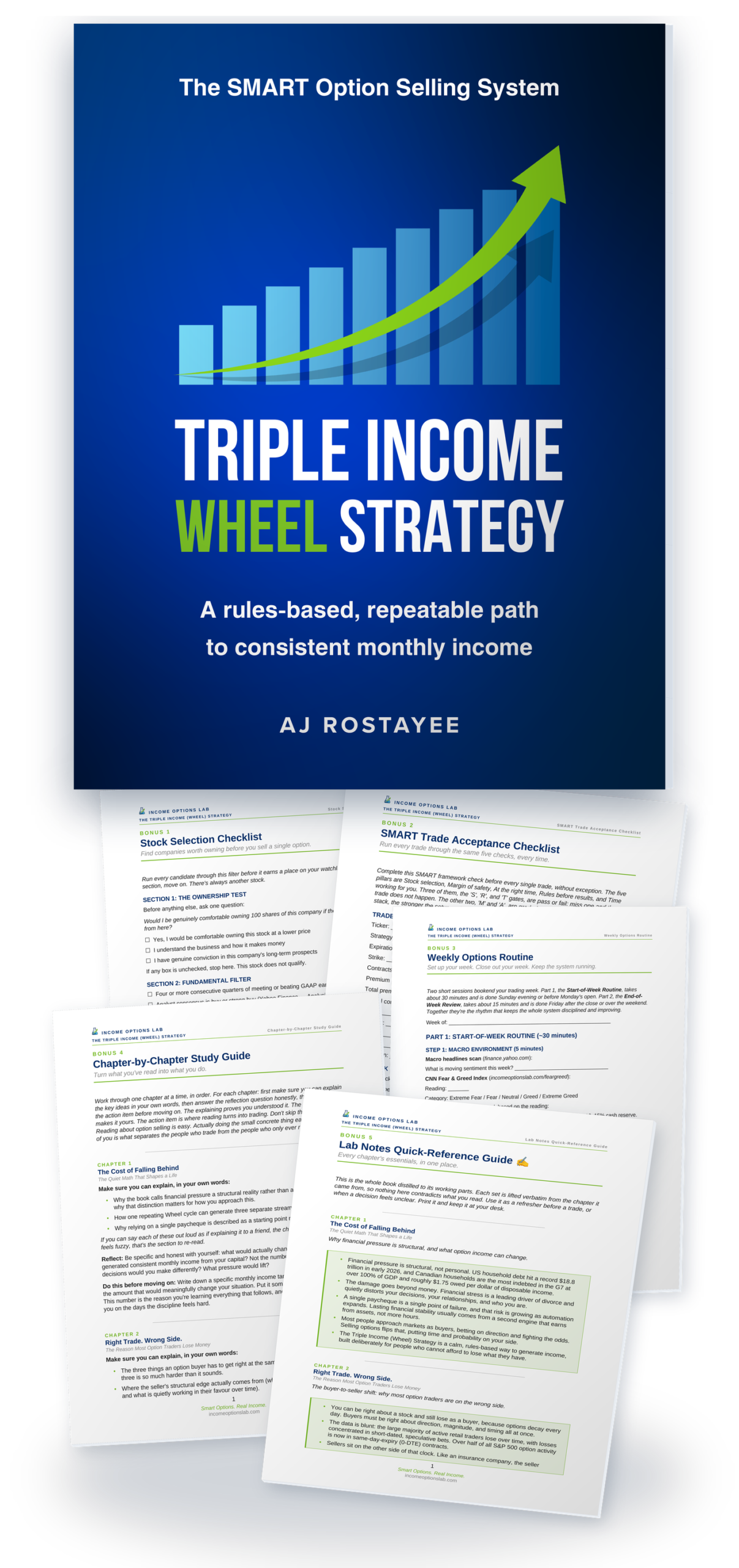
The SMART Option Selling System™
The complete decision process behind cash-secured puts and covered calls: which companies qualify, where the strike goes, how much to risk, when to act — and what to do when a trade turns against you.
The Triple Income (Wheel) Strategy gives you a rules-based, repeatable way to put your capital to work toward consistent monthly income, with a defined process for the decisions that come before, during and after each trade.
95-page digital book + 5 practical implementation tools
Get the Complete System — $49 USDOne-time payment • Secure checkout •
Instant digital access • 14-day guarantee
Sell a cash-secured put.
If you're assigned, you own the shares.
Sell a covered call.
Eventually the shares may be called away.
That's the Wheel.
But knowing the mechanics doesn't tell you:
Which company deserves your capital?
Where should the strike actually go?
Is today a good day to enter — or should you wait?
How much of your account should one position consume?
What happens when the stock falls through your strike?
Should you roll, accept assignment, close — or do nothing?
And perhaps the hardest question of all:
When should you do absolutely nothing?
When those answers aren't decided in advance, every trade becomes a fresh judgment call made while money, fear, greed and uncertainty are competing for your attention.
That's where a simple income strategy quietly becomes something else:
The Wheel isn't the problem.
The lack of a system is.
I didn't invent the Wheel.
SMART is how I organized the decisions around it into a framework I could follow consistently when real money and real emotion were involved.
The five pillars are stock selection first, margin of safety in strike selection, at the right time, rules before results, and time working for you.
At the right time. Use volatility, price action and technical confluence to improve when you enter.
If one fails, the trade doesn't happen.
The more evidence that lines up in your favour, the stronger the setup.
That distinction is deliberate. SMART stays strict where a broken rule can jeopardize your capital, and flexible where real markets require judgment.
The goal isn't to predict every move.
It's to know what has to be true before you risk your money, and what you'll do next if the market doesn't cooperate.
The Wheel becomes the Triple Income Strategy because one complete cycle can produce three separate streams.
Sell a cash-secured put on a quality company at a price you'd genuinely be willing to pay. Collect premium up front. If you're not assigned, reassess and repeat. If you are, move to the next phase.
Once you own the shares, sell calls against them at strikes deliberately chosen above your cost basis. You collect another premium while you wait.
If the shares are eventually called away above your cost basis, the cycle can finish with a gain on the stock itself.
That's Triple Income.
And assignment?
When you begin with a company you genuinely want to own, assignment simply moves you from one side of the cycle to the other.
Tap to view the full cycle
Chapter 8 walks through one full cycle, from the first put to the final exit, using an illustrative company.
In the example:
$400 total on $2,000 of committed capital, over a cycle of roughly ten weeks.
These are illustrative numbers used to show how the three streams connect — not a promise or projection of what any reader will earn.
The point is to show how assignment changes the position, how each income stream is tracked, and how a disciplined trader thinks through the uncomfortable middle when the stock temporarily moves the wrong way.
Real markets are messy. Your process shouldn't be.
You shouldn't have to buy a trading product based on a polished cover and vague promises.
So look at the actual system.
Both seats at the table — why the seller sits on a structurally different side of the trade.
Premium anatomy — what you're actually being paid for, and why time works for the seller.
The 45-minute week — the routine that keeps the process running without living at the screen.
The mental game — the five ways disciplined traders break their own rules, and how to catch yourself.
BUILT TO BE UNDERSTOOD
Options come with enough jargon already. I wrote this the way I'd explain it to a friend across the table: plain English first, with concrete examples and analogies that make the mechanics easier to picture.
You won't just be told what to do. The book explains why the rule exists, what it's protecting you from, and how to think when the market doesn't follow the clean textbook example.
Because memorizing a setup can get you through one trade. Understanding the process helps you make sound decisions when the next trade looks different from the last one.
What you see is what you get. Specific rules, decision points and tools designed to be used — not a hidden "secret strategy" revealed after checkout.
Financial pressure was the reason I came to option selling.
It was also the reason I nearly sabotaged it.
I've spent more than 25 years in and around financial markets, across equities, futures, forex and crypto. In the fall of 2024, I moved seriously into options.
I paid for mentorship from experienced traders. I studied the mechanics. And I put real capital behind what I was learning.
And the pressure that brought me here started dictating how I traded.
I traded too often.
I moved into shorter-dated positions because the money came faster.
I sized too aggressively.
I leaned too heavily on leverage.
And when trades went against me, I sometimes tried to win the money back instead of following the plan.
I lost roughly half of my starting options capital during that first year.
Not because I had never heard of risk management.
Because pressure caused me to break rules I already knew.
That was the expensive difference between knowing a strategy and having a process strong enough to follow when you're under pressure.
SMART is how I organized what I'd learned — from decades around markets, substantial paid education, and my own mistakes — into a framework I could actually follow.
I didn't invent the Wheel. I'm not claiming to have invented stock selection, position sizing or risk management either.
What I built is the operating process that connects those decisions together.
Capital protection first. Income second.
Because one spectacular trade isn't the goal. Building a process you can still be following years from now is.
The Triple Income (Wheel) Strategy is delivered as a 95-page digital book plus five companion implementation tools.
The book takes you from the foundations through actual execution:
Why selling changes the odds — time decay, probability, and why the seller sits on a fundamentally different side of the trade.
How to choose the underlying company — businesses you'd genuinely be willing to own, screened for fundamentals, valuation and options liquidity. Fundamentals decide whether the company qualifies; the chart helps decide when.
How to apply SMART — a defined decision process behind stock selection, strike placement, timing, rules and expiration.
How to run both sides of the Wheel — cash-secured puts, assignment, covered calls, and completing the cycle.
How to expand beyond the Wheel without abandoning it — an 80/20 framework that keeps the Wheel as the income core while introducing bull put spreads, LEAPS and other selective tools for situations where the standard Wheel isn't the best fit.
How to protect and manage the account — concrete guardrails for position size, sector concentration, cash and margin, plus a 21-DTE decision framework for when to roll, accept assignment, close for a loss, or do nothing.
How to make it repeatable — a weekly operating rhythm, and the psychology required to follow your own rules.
You don't finish with another collection of trading ideas.
You finish with a process.
Find companies worth owning before you sell a single option.
Run every candidate through the ownership test, fundamentals, valuation, liquidity and risk flags before it earns a place on your watchlist. The first question is intentionally simple: would I genuinely be comfortable owning 100 shares if this company dropped 20% from here? If the answer is no, it doesn't qualify.
Make every trade earn its way into your portfolio.
Before money goes on the line, evaluate SMART, position sizing and your own psychology. The checklist ends with two possible outcomes: APPROVED or NOT APPROVED.
A trade doesn't go on because you like it. It goes on because it qualifies.
Set up the week. Close out the week. Keep the process running.
A structured start-of-week review of the environment, your positions and your watchlist, followed by a short end-of-week review of your results and your discipline. Roughly 30 minutes at the start of the week and 15 at the end, with research and trade management handled as needed.
And if nothing qualifies after the start-of-week review? Cash is the position.
The Friday review then looks across the whole week for rule drift, recurring emotional patterns, and the one adjustment you'll carry into the next week.
Turn reading into action.
Every chapter moves through three steps: explain it, reflect on it, do something. Reading creates understanding. Application builds the skill.
The working parts of the book, distilled.
Keep the essential chapter takeaways beside you while you trade — for when a rule feels fuzzy, when you're managing a position, or when you need a quick reminder without rereading a chapter.
You can learn what a cash-secured put is on YouTube.
You can look up covered calls, delta, theta and assignment without spending a dollar.
That isn't what you're paying for.
The value is in connecting the decisions:
What deserves your capital?
When does the setup qualify?
Where does the strike belong?
How much do you risk?
What happens when the position moves against you?
When do you take the win?
When do you cut at a loss and redeploy into a better setup?
When do you stop?
The rules in this book cost me half a trading account to learn.
The purpose of this system isn't to eliminate losing trades.
It's to put rules between an opportunity and your money before emotion gets a vote.
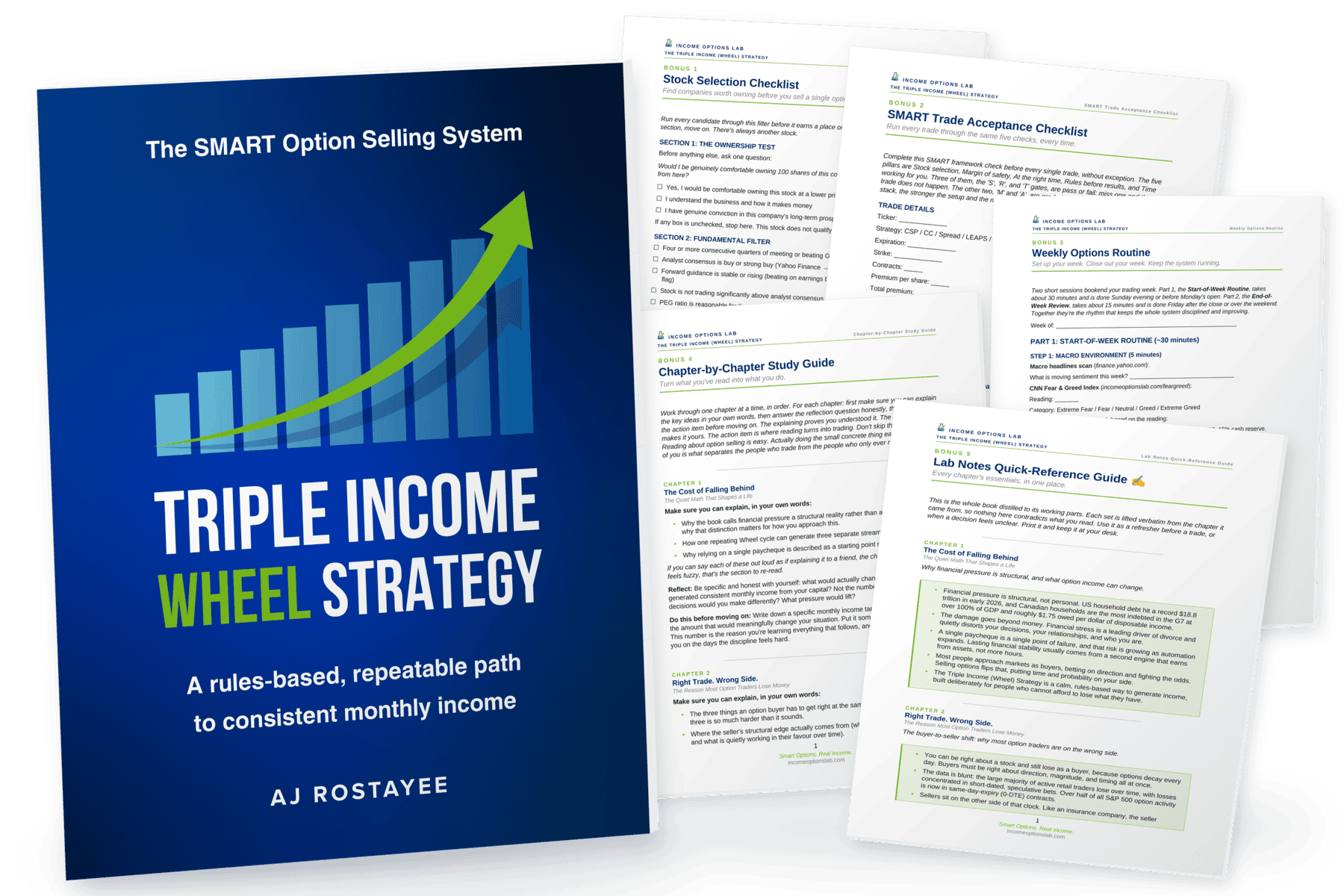
The Triple Income (Wheel) Strategy — 95-page digital book
PLUS all five implementation tools:
Stock Selection Checklist
SMART Trade Acceptance Checklist
Weekly Options Routine
Chapter-by-Chapter Study Guide
Lab Notes Quick-Reference Guide
$49 USD
Get the Complete SystemWork through the material. If it isn't what you expected, email support@incomeoptionslab.com within 14 days of purchase with a brief note on what you tried and what didn't meet your expectations, and I'll refund your purchase.
The Triple Income Strategy is intentionally boring in all the ways good risk management tends to be.
If that sounds reassuring rather than disappointing, you're probably in the right place.
This is not a get-rich-quick product.
Options involve real risk, and no framework can guarantee income, profits or the outcome of an individual trade.
Some trades will win. Some will lose. Some weeks will offer strong opportunities. Other weeks the right decision may be to stay in cash.
The purpose of SMART is not to force the market to produce a result.
Educational purposes only. Options involve substantial risk.
Yes, provided you're willing to learn. The book includes a plain-English options primer before moving into SMART and the Wheel itself, so you don't need years of experience. But this isn't a "click these buttons" guide — the objective is to teach you how to make the decisions, not remove the need to think.
That depends on whether you're still improvising the decisions around the trade. If you already have written, consistently followed rules for stock qualification, strike placement, timing, sizing, management and assignment, you may not need this. If you understand the Wheel mechanically but still decide those things in the moment, that's exactly the gap SMART is designed to address.
You can learn most of the individual concepts for free. The product isn't the definition of a covered call. It's the connected operating process around the trade, plus the checklists and routine designed to help you follow it.
No. This isn't a stock-pick or trade-alert service. You'll learn a process for deciding which companies qualify for your own watchlist, including the ownership test, fundamental criteria, liquidity and risk checks.
There's no universal minimum. Cash-secured puts and covered calls involve obligations tied to 100 shares, so the capital required depends heavily on the stock price. The book also introduces more capital-efficient strategies beyond the core Wheel, but the core philosophy holds: don't stretch an account beyond what it can safely support just to make a trade fit.
No. The book reduces the setup to a broker, a fundamentals source, a charting platform and a way to model a trade before you place it. It also points you to the tools I actually use, including free or lower-cost options where appropriate. The process matters far more than the software stack.
The structured Weekly Options Routine is designed around roughly 30 minutes at the start of the week and 15 at the end. Research, entries and position management may require more, depending on your portfolio and conditions. The goal is a deliberate rhythm, not constant screen-watching.
No. No legitimate trading strategy can guarantee a particular income or return. The system is designed to help you pursue option income through better stock selection, trade structure, risk management and repeatable execution. Your results will depend on your capital, decisions, discipline, experience and market conditions.
Yes. Markets change, tools change, and my own workflow keeps evolving. When a revised edition is released, existing buyers can request a copy at no additional charge by emailing support@incomeoptionslab.com with proof of purchase.
The 95-page digital book and all five companion implementation tools, as downloadable PDFs. They read well digitally, and the checklists, Weekly Routine and Lab Notes are particularly useful printed beside your trading desk.
Your purchase is covered by a 14-day guarantee. Work through the material, and if it isn't what you expected, email support@incomeoptionslab.com within 14 days of purchase with a brief note on what you tried and what didn't meet your expectations, and I'll refund your purchase.
Yes. If you join The Lab later, the amount you paid for The Triple Income (Wheel) Strategy is credited toward your membership. The credit doesn't expire, can be used only once, has no cash value, can't be combined with another credit or offer, and isn't available if you've had the book refunded.
You need to know what you'll do before money is on the line.
What qualifies. What doesn't. Where the strike goes. How much you'll risk. When you'll enter. When you'll take the win. What happens if you're assigned. What happens if you're wrong.
And when the smartest decision is to wait.
That's the difference between knowing a strategy and running a process.
Learn the rules. Build the routine. Put your capital to work.
The Triple Income (Wheel) Strategy
A rules-based, repeatable path to consistent monthly income
95-page digital book + 5 implementation tools
$49 USD
Get the Complete SystemOne-time payment • Secure checkoutInstant digital access • 14-day guarantee